
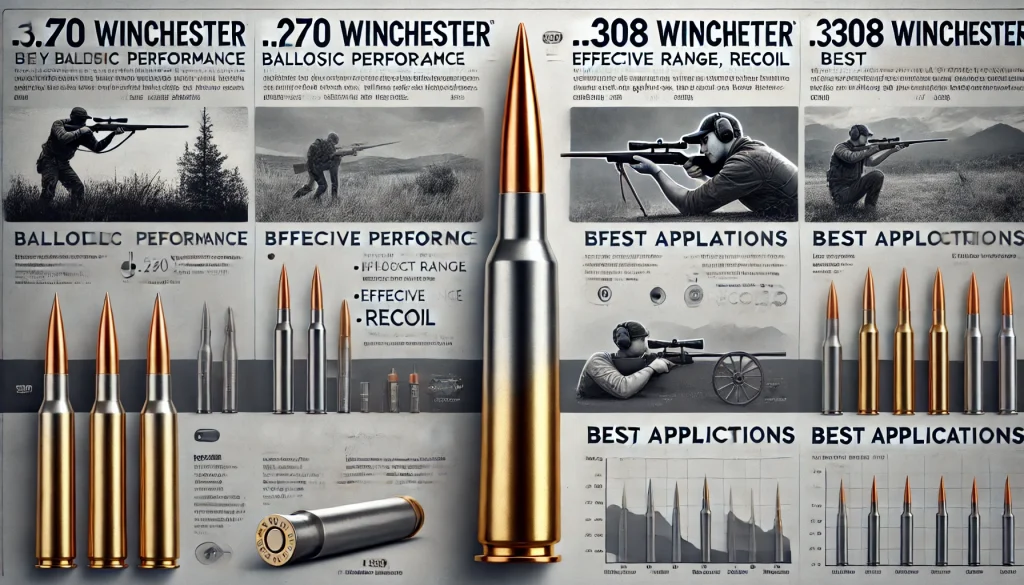
The .270 Winchester and .308 Winchester are among the most popular rifle cartridges for hunting. Each cartridge has its own unique characteristics, making them suitable for different types of game and hunting experiences. This overview will explore the differences and similarities between the .270 and .308, helping you determine which of the two cartridges is better suited for your needs.
Key Takeaways:
- The 270 and 308 are popular hunting cartridges with distinct differences in caliber, bullet size, velocity, and recoil.
- Both cartridges have a similar origin and history, making them equally suitable for hunting various game animals.
- When choosing between the 270 and 308, factors like personal preference, hunting conditions, and ammunition availability should be considered.
What Are 270 and 308?
The .270 Winchester and .308 Winchester are two of the most popular cartridges in the hunting and shooting communities, each offering distinct advantages that make them suitable for various applications.
Developed in the early 20th century, these cartridges have become staples among hunters and shooters, particularly for big game hunting.
The .270 Winchester is renowned for its high velocity and flat trajectory, making it a preferred choice for long-range shooting.
In contrast, the .308 Winchester is celebrated for its versatility and effective performance across a wide range of game and shooting conditions.
What Are the Differences Between 270 and 308?
The differences between the .270 and .308 cartridges can be summarized as follows:
- The .270 cartridge offers better long-range performance, while the .308 excels in short-range scenarios.
- The .270 has less recoil compared to the .308, which produces more recoil.
- In terms of wind performance, the .270 performs better, whereas the .308 performs less effectively against wind.
- The .270 experiences less bullet drop, while the .308 has more bullet drop.
- Additionally, the .270 is generally cheaper than the .308, making it a more economical choice.
- For hunting purposes, the .270 is preferred for deer hunting, while the .308 is favored for hunting larger game such as moose and bear.
- Both cartridges offer a variety of ammunition options, but the .270 has a wider selection.
- The .270 fires faster bullets, though it has less energy at the target compared to the .308, which delivers more energy despite its slower bullets.
- While both cartridges are suitable for hunting and sporting activities, the .308 is considered more powerful and versatile than the .270.
- Both the .270 and .308 are American cartridges, with the .270 classified as a light recoiling cartridge and the .308 as a moderate recoiling cartridge.
- Both cartridges fall into the medium caliber category.
In summary, the .270 is better suited for deer hunting at longer distances, while the .308 is more appropriate for larger game like moose and bear.
1. Caliber and Bullet Size
The caliber and bullet size of the .270 Winchester and .308 Winchester are fundamental features that distinguish the two cartridges, significantly influencing their effectiveness for different types of game.
The .270 typically uses bullets weighing between 130 and 150 grains, which are known for their flatter trajectory and higher sectional density, making this cartridge ideal for long-range engagements. In contrast, the .308 offers a broader range of bullet weights, from 150 to 180 grains, allowing for greater flexibility in selecting the right bullet for specific hunting needs.
The choice of caliber and bullet size not only affects trajectory but also plays a crucial role in energy transfer upon impact. The .270, with its lighter bullets, often delivers rapid expansion but transfers less energy at close ranges. Meanwhile, the heavier bullets of the .308 can achieve deeper penetration, making them more effective for larger game.
Additionally, the versatility of the .308 accommodates various bullet types—including soft points, hollow points, and even match-grade options—catering to different hunting scenarios.
These factors are critical for terminal performance, as hunters must consider both the energy delivered and the bullet’s ability to penetrate and expand effectively within their chosen targets.
2. Velocity and Trajectory
Velocity and trajectory are critical factors in understanding the performance differences between the .270 and .308 cartridges, especially in hunting scenarios where precision is essential.
The .270 Winchester is well-known for its high muzzle velocity, often exceeding 3,000 feet per second. This high velocity contributes to a flatter trajectory, enabling more accurate long-range shots. In contrast, the .308 Winchester typically offers slightly lower velocities, ranging from 2,600 to 2,800 feet per second, but compensates with greater downrange energy, making it effective at various distances.
This difference in velocity not only affects the initial speed at which the bullet travels but also fundamentally influences its behavior over distance, particularly concerning bullet drop and wind drift.
The flatter trajectory of the .270 allows shooters to engage targets with less elevation adjustment, which is advantageous in open terrains. On the other hand, the .308 experiences more bullet drop over the same range but exhibits less susceptibility to wind drift due to its superior mass and retained energy.
As a result, hunters often consider these factors when selecting a cartridge, particularly in environments where distance and wind conditions can vary significantly, such as mountainous regions or open plains.
In these scenarios, they must decide whether to prioritize speed and trajectory or energy transfer and stability.
3. Recoil and Accuracy
When choosing between the .270 and .308 cartridges, recoil and accuracy are essential considerations for shooters. Generally, the .270 Winchester is perceived to have less recoil because of its lighter bullet weights, which enables shooters to maintain better control and accuracy during follow-up shots.
In contrast, while the .308 Winchester exhibits more recoil, it offers robust performance and can achieve remarkable accuracy with its varied bullet weights, making it popular among both precision shooters and hunters.
Understanding the nuances of recoil can significantly influence a shooter’s experience and performance. For instance, experienced shooters may adjust their stance, grip, or even the type of stock on their rifles to mitigate recoil while optimizing accuracy.
Those who prefer the .270 often appreciate how its lighter ammunition facilitates quicker target acquisition and provides a more comfortable shooting experience, particularly during long sessions at the range. Conversely, some .308 users may choose aftermarket components like recoil pads or muzzle brakes to enhance their shooting comfort, allowing them to leverage the cartridge’s impressive stopping power without sacrificing performance.
Feedback from seasoned hunters indicates that adapting techniques based on cartridge choice can lead to better results and a more enjoyable shooting experience.
What Are the Similarities Between 270 and 308?
The .270 and .308 cartridges share several similarities that contribute to their popularity among hunters and shooters. Both cartridges are widely available and supported by a diverse range of factory loads, making it easy for shooters to find suitable ammunition for various game types, including deer, elk, and moose.
They also boast a long history within the hunting community, which has fostered a strong network of enthusiasts who appreciate the distinct performance characteristics of each cartridge.
1. Origin and History
The .270 Winchester and .308 Winchester cartridges were developed for American hunters and military use, showcasing the evolution of firearms over the years. Introduced in 1925 by Winchester, the .270 Winchester was designed as a hunting cartridge, particularly for big game, due to its high velocity and flat trajectory.
In contrast, the .308 Winchester emerged as a military cartridge in the late 1950s, based on the 7.62x51mm NATO cartridge, and it was later adopted by many civilian hunters as well.
Both the .270 and .308 cartridges hold historical significance. The .270 cartridge gained prominence through the influence of renowned outdoor writer Jack O’Connor, who established it as the de facto hunting cartridge for large game. O’Connor’s tales of hunting caribou in Alaska, sheep in the Canadian Rockies, and deer and elk in the western U.S. popularized the .270 and its 130-grain bullet.
He even named the rifle he used in Africa “The African” due to his success in taking 15 African game animals with it.
The military version of the .308 Winchester was designed to replace the .30-06 Springfield cartridge, offering less recoil and easier handling in poorly designed rifles. The first military rifles chambered for this cartridge included the semi-automatic M1 Garand and the bolt-action M1903.
Over the years, the .308 Winchester has been adopted by various military establishments worldwide and has become a favorite among civilian hunters, appealing to a diverse range of users from varmint and deer hunters to long-range shooting enthusiasts.
2. Suitable Game for Hunting
Both the .270 and .308 cartridges are excellent choices for hunting a wide range of game species, making them two of the most popular cartridges among hunters in North America and around the world.
The .270 Winchester cartridge is particularly well-suited for taking medium to large game, such as deer and elk, due to its high velocity and accuracy, making it a favorite among precision shooters. On the other hand, the .308 Winchester offers greater versatility, allowing hunters to take game ranging from deer to larger animals like moose, thanks to its wide selection of bullet weights, reliable stopping power, and effective range.
The .270 is often the preferred choice in open fields and for longer shot distances, where shooting accuracy is paramount due to its flat trajectory and aerodynamic bullet design. Conversely, the .308 is typically favored in dense woods and varied terrain, where its versatility becomes a key advantage. It can be loaded with a range of bullet weights, enabling hunters to select the most appropriate option based on the specific game being pursued—heavier bullets for larger animals and lighter bullets for smaller ones, highlighting the pros and cons of each cartridge in different scenarios.
Hunters frequently reminisce about successful moose hunts in the rugged landscapes of western Canada using the .308 cartridge, known for its stopping power and energy transfer, while others recall tracking mule deer in the open valleys of the American West with the flat-shooting .270, celebrated for its long-range performance and lower recoil.
This combination of precision and power in both cartridges provides hunters with the flexibility to effectively pursue game in diverse environments, demonstrating the depth of each cartridge’s design and performance capabilities.
3. Availability and Cost
The availability and cost of .270 and .308 hunting ammunition are comparable, making both cartridges appealing options for hunters seeking reliable and affordable ammunition. Manufactured by various brands, these cartridges offer a wider range of factory loads than any other centerfire cartridge, including popular models like the Winchester Model 70 and Mauser rifle, ensuring hunters can find .270 or .308 options that meet their needs in local stores or online. Both cartridges are typically priced similarly, making them suitable choices for both beginner and experienced shooters.
Market trends significantly influence the supply and demand for .270 and .308 ammunition, as fluctuations in production quantities can either expand or limit the selection available to consumers. For instance, during hunting season, increased demand may result in limited options, affecting pricing and purchasing patterns, especially for popular rifles used in both military and civilian applications.
Conversely, enhanced production capacity can lead to lower prices, making these cartridges even more attractive. These trends are crucial for hunters to understand, as they can impact purchasing decisions. Consistent availability can either strengthen customer loyalty to a particular cartridge or prompt them to seek alternatives.
Which One Is Better for Hunting?
Determining whether the .270 or .308 cartridge is better for hunting is subjective and largely depends on the type of game, shooting conditions, and the personal preferences of each hunter, with consideration of factors such as ballistic coefficient and sectional density.
Both cartridges have proven effective in the field, but individual experiences and specific hunting scenarios, including recoil management and action rifle models used, play a significant role in making the right choice.
By considering factors such as recoil, accuracy, and the availability of bullet options, hunters can decide which cartridge best suits their particular needs.
1. Factors to Consider
When deciding between the .270 Winchester and the .308 Winchester for hunting, several key factors should be considered, including the type of game being pursued, shot distance, hunting environment, and the hunter’s comfort level with recoil. The performance of each caliber in these areas can help determine the best choice.
For instance, the .308 Winchester is more suitable for hunting large game like elk or moose due to its heavier 180 grain bullets and greater stopping power. Conversely, the .270 Winchester is preferable for deer hunting in open fields where long-range shots are typical, as it offers a flatter trajectory and lower recoil, often using 130 grain bullets for enhanced accuracy.
In densely wooded environments, maneuverability and quick follow-up shots may take precedence, making the .308’s wider variety of bullet types particularly advantageous. Meanwhile, in open plains, the .270’s aerodynamic bullet design may prove more effective.
2. Personal Preference and Experience
Personal preference and prior experience play significant roles in a hunter’s decision between the .270 and .308 cartridges, influencing both comfort and performance in the field, often swayed by the cartridge’s ballistic history and the hunter’s prior successes.
Many seasoned hunters develop a preference based on their shooting style, experiences with recoil management, and the accuracy they achieve with each cartridge. Understanding one’s own biases and familiarity with both options can guide the selection of the most suitable cartridge for individual needs.
For instance, a hunter who started their journey with the .270 may feel more comfortable due to its flatter trajectory and perceived lower recoil, which can enhance confidence in various hunting scenarios. Conversely, another individual who frequently uses the .308 may value its versatility in terminal ballistics and effectiveness in anchoring larger game.
This personal history not only shapes their choice but also impacts outcomes in the field; those who are comfortable with their cartridge often report greater accuracy and a higher success rate during hunts, leveraging the pros of their chosen cartridge’s design and capabilities.
Anecdotes from experienced hunters illustrate how a single memorable hunt can reinforce cartridge preference, highlighting the deep connection between past experiences and present choices.
3. Game and Hunting Conditions
The type of game being hunted and the hunting conditions play a significant role in determining whether the .270 or .308 cartridge is better suited for a successful hunt. Depending on the distance, terrain, and environmental conditions, either cartridge may be more appropriate. The .270 is often preferred for long-range shots in open fields, especially with 130 grain bullets, while the .308 is favored in thick woods or for larger game due to its greater knockdown power and the use of 180 grain bullets.
For instance, when hunting in wide-open areas such as plains or uplands, the flat trajectory of the .270 allows hunters to take advantage of increased distance and make accurate shots at longer ranges. Shooters have reported success with this cartridge when hunting deer at distances exceeding 300 yards, utilizing its high velocity and ballistic properties.
In contrast, when hunting in dense woods or targeting larger game such as elk or bear, the heavy construction of the .308 bullet provides hunters with added confidence and reliability for making stopping shots, often utilizing the 7.62x51mm NATO dimensions for consistency and performance.
One example illustrating this point is a story about a hunter who adapted to challenging conditions by switching to the .308 while hunting in heavy brush, ultimately leading to a successful elk harvest. This demonstrates that understanding the dynamics of bullet effectiveness in relation to specific hunting conditions can often be the deciding factor in achieving successful hunting trips.
Which One Is More Versatile?
Versatility is a crucial consideration for cartridges used by hunters and shooters who may require the same cartridge for different applications.
In this regard, both the .270 and .308 cartridges present unique advantages. The .270 Winchester is often regarded as a specialty cartridge for long-range hunting, particularly effective for medium to large game, and is frequently associated with influential hunters like Jack O’Connor of Outdoor Life fame.
In contrast, the .308 Winchester is recognized for its versatility across various shooting disciplines, making it one of the most popular cartridges among military, civilian, and recreational shooters, often compared favorably against cartridges like the .30-06 Springfield and the 6.5 Creedmoor.
1. Hunting and Shooting Applications
The hunting and shooting applications of the .270 and .308 cartridges demonstrate their versatility, each catering to different preferences and scenarios. The .270 is often favored for hunting game such as deer and elk in open terrain, where its high velocity and flat trajectory offer advantages for long-range shots, benefiting from its sectional density and ballistic efficiency.
In contrast, the .308 is suitable for a broader range of shooting applications, including hunting various species and tactical or precision shooting, thanks to its effectiveness and the availability of numerous bullet options, such as the 150 grain and 180 grain variants, enhancing its performance in different scenarios.
For example, the .270 excels in situations where a hunter needs a quick and accurate long-range shot, making it ideal for mountainous regions or expansive fields with minimal cover, where its ballistic coefficient provides enhanced accuracy. On the other hand, the .308 is particularly effective in environments that require adaptability, such as densely wooded areas or when hunting smaller game like wild hogs, benefiting from its heavier bullet weights and energy capacity.
Its heavier bullets provide penetration through thick hides, and its excellent stopping power makes it a reliable choice for both hunting and competitive shooting. This adaptability is enhanced by a wide variety of bullet weights and designs, allowing shooters to select the optimal round for their specific needs.
2. Ammunition Options and Availability
Both the .270 and .308 cartridges offer a wide range of ammunition options and are readily available, making them popular choices for hunters and recreational shooters alike.
The .270 Winchester features factory loads with various bullet weights and designs, including lighter bullets for fast, flat shooting and heavier loads for improved energy transfer at long range, making it a well-rounded option for diverse scenarios. Similarly, the .308 Winchester is available in a diverse array of bullet weights and designs, enhancing its reputation for versatility across different hunting applications, with options like the 7.62x51mm NATO and .30-06 Springfield enriching its ballistic lineage.
This diversity enables hunters to select the appropriate ammunition based on the size and environment of their target, whether they are pursuing deer in open fields or larger game in wooded areas, optimizing performance through careful selection based on sectional density and bullet design.
For instance, a lighter .270 load might be ideal for hunting coyotes and other varmints due to its increased speed and flat trajectory, offering minimal recoil and high precision, while the heavier bullets of the .308 are highly effective for delivering stopping power on larger animals such as elk, leveraging their greater energy and penetration capabilities.
Both cartridges enjoy a wide market availability, with many popular factory loads from reputable manufacturers such as Winchester, ensuring that users have reliable options to choose from. This extensive selection not only optimizes performance but also provides reassurance to those who rely on these cartridges in the field, whether for military or civilian use.
3. Performance on Different Game Animals
The performance of the .270 Winchester and .308 Winchester cartridges on various game animals highlights the strengths and weaknesses of each option, offering valuable insights for hunters. The .270 Winchester is particularly effective for medium-sized game, such as deer and antelope, as it delivers rapid kills with minimal meat damage due to its high velocity and effective ballistic coefficient. In contrast, the .308 Winchester shines in scenarios involving larger game, such as moose and bears, where its heavier bullet options, like the 180 grain, provide superior stopping power and penetration.
Hunters often choose the .270 for its flatter trajectory and lower recoil, which enables quick follow-up shots when pursuing agile animals like antelope in open plains. For example, a hunter stalking a herd may find that the speed of the .270, with its 130 grain bullet, allows for more precise shots at longer distances.
Conversely, when hunting heavier game like elk in dense forests, the .308’s capacity to deliver a powerful punch becomes essential. The increased energy transfer from the .308’s heavier projectiles, such as the 150 grain and 180 grain bullets, can make a significant difference in ensuring a clean and ethical kill, especially when a swift resolution is necessary to avoid losing the animal.
Frequently Asked Questions
What is the difference between a 270 and a 308 rifle?
The main difference between a 270 and a 308 rifle is the caliber, or the diameter of the bullet. A 270 rifle has a caliber of .277 inches, while a 308 has a caliber of .308 inches. This may seem like a small difference, but it can have a significant impact on performance, especially in terms of sectional density and ballistic properties.
Which rifle is better for long-range shooting, a 270 or a 308?
Both the 270 and the 308 are capable of long-range shooting, but the 270 has a slight edge due to its flatter trajectory and higher velocity. This means that the bullet will drop less over long distances, making it easier to hit targets at extended ranges, an aspect that is especially appreciated in precision shooting disciplines.
Is there a significant difference in recoil between the 270 and the 308?
The 270 and the 308 have similar levels of recoil, but the 308 may have slightly more due to its larger bullet size. However, the recoil can also be affected by the weight of the rifle and the type of ammunition used.
Which rifle is better for hunting, a 270 or a 308?
Both the 270 and the 308 are popular for hunting, but it ultimately comes down to personal preference. The 270 is known for its flat trajectory and long-range accuracy, favored by hunters like Jack O’Connor and popularized through publications like Outdoor Life, while the 308 is known for its versatility, availability of ammunition, and history of use by the US Army as the 7.62x51mm NATO.
What types of game are suitable for hunting with a 270 or a 308?
The 270 and the 308 are both suitable for hunting medium to large game, such as deer, elk, and moose. The 270 may be better for longer shots and smaller game, offering precision and minimal recoil, while the 308 may be better for closer shots and larger game due to its larger bullet size, increased energy, and stopping power.
Which rifle is more popular, the 270 or the 308 among shooters?
The 308 is generally more popular and widely used among hunters and shooters, partly due to its extensive use in military applications and action rifles like the Winchester Model 70. However, the 270 also has a strong following, especially for those interested in long-range precision and hunting game in open terrains. Both rifles have their own unique advantages, and it ultimately depends on the individual’s needs and preferences.